%20(10).png)
The balanced scorecard is a strategy framework that measures an organization's performance from four perspectives: financial, customer, internal processes, and learning and growth. Robert S. Kaplan and David P. Norton introduced it in a 1992 Harvard Business Review article as an alternative to managing by financial figures alone. Over the following years, it grew from a measurement system into a tool for describing, communicating and carrying out strategy.
The short answer: a balanced scorecard turns strategy into goals and measures across four perspectives, and a strategy map shows how those goals depend on each other. It suits organizations that want to manage strategy as a whole, especially larger organizations and the public sector. Its biggest risk is collecting too many measures.
This article explains the four perspectives, how a strategy map works and how to build a scorecard step by step. If you're still choosing between frameworks, start with OKR vs Balanced Scorecard vs Hoshin Kanri.
The four perspectives of the balanced scorecard
Each perspective answers one question about the strategy. Together they give a balanced view: financial results show what has already happened, while the other three show what drives results in the future.
Table: Balanced scorecard perspectives with examples
| Perspective | The question it answers | Example objective | Example measure |
|---|---|---|---|
| Financial | How do we create value for owners or funders? | Grow recurring revenue | Annual recurring revenue |
| Customer | How do customers see us? | Become the first choice for existing customers | Customer retention rate |
| Internal processes | What must we excel at? | Shorten delivery time | Average lead time from order to delivery |
| Learning and growth | How do we keep improving? | Build skills for new services | Share of staff trained in key skills |
The examples above are illustrative. Every organization chooses its own objectives and measures based on its strategy, and that choice is the most important part of the work.
In the public and nonprofit sectors, the order of perspectives is often changed. The mission sits at the top instead of the financial perspective, because money is a means rather than the goal.
What is a strategy map?
A strategy map is a one-page picture of the strategy that shows how the objectives in the four perspectives depend on each other. Kaplan and Norton developed the idea later and described it in detail in their 2004 book Strategy Maps. The map explains what a list of measures can't: why each measure matters.
Figure: Illustrative example of a strategy map
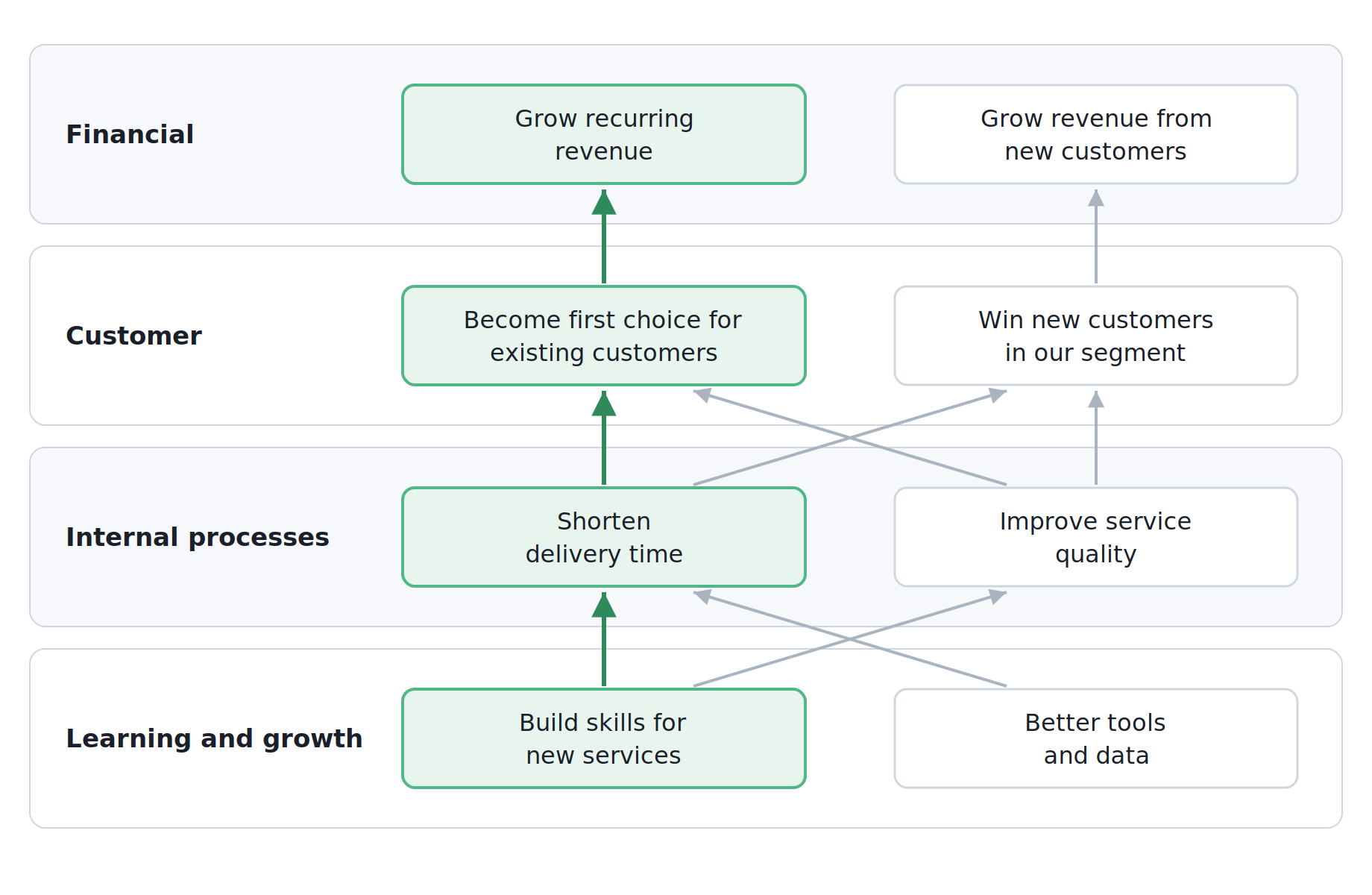
The map is read from the bottom up, following cause and effect:
Learning and growth → internal processes → customer → financial
Using the examples above: when people learn new skills, delivery gets faster; faster delivery keeps customers coming back; and loyal customers grow recurring revenue. Each arrow is a hypothesis about how the strategy works.
That is also what makes the map useful in practice. If the measures in the lower perspectives improve but results higher up don't follow, the hypothesis is wrong, and the strategy needs to be revisited rather than the measures simply tracked harder. A good strategy map fits on one page. If it doesn't, the strategy hasn't been prioritized enough yet.
How to implement a balanced scorecard
- Clarify the strategy first. A scorecard can only measure choices that have been made. If leadership can't state the strategy in a few sentences, start there.
- Draft the strategy map. Set a few objectives for each perspective and draw the cause-and-effect links between them. Prioritize hard: the map should fit on one page.
- Choose measures and targets. Give each objective one or two measures and a target. Include both lagging measures, which show the existing results, and leading measures, which predict the upcoming ones.
- Define initiatives. Decide which projects or actions will move each measure, and who owns them. A measure without an initiative is just a number to watch.
- Break it down for units and teams. Build unit-level scorecards that show how each part of the organization contributes to the overall strategy.
- Review regularly. Hold strategy reviews, for example quarterly, where leadership looks at the measures and asks whether the cause-and-effect assumptions still hold. Update the map when they don't.
Common balanced scorecard mistakes
- Too many measures. The most common problem. When every department adds its favorite indicators, the scorecard becomes a reporting exercise and the strategy disappears behind the numbers.
- A scorecard without a strategy map. If measures are picked one by one without cause-and-effect logic, they don't demonstrate how the strategy is supposed to work.
- Measuring only what is easy to measure. Learning and growth objectives are often the hardest to measure, so they end up missing the purpose or get skipped. Yet they drive everything above them.
- Building it once and filing it away. A scorecard that is reviewed once a year doesn't steer anything. Its value comes from regular strategy discussions.
When does a balanced scorecard fit?
A balanced scorecard is a good choice when you need a complete, balanced view of strategy and want different parts of a larger organization to support the same whole. That is why it is common in the public sector, in larger companies and in organizations with several units.
It is a weaker fit when the priority is speed and sharp focus, for example in a fast-growing company where priorities change every quarter. In that case, OKRs often work better, or the two can be combined: the scorecard sets the long-term structure and OKRs define the focus for each quarter. Read more in OKR vs Balanced Scorecard vs Hoshin Kanri.
Sources
- Kaplan, R. S. & Norton, D. P. (1992). The Balanced Scorecard: Measures That Drive Performance. Harvard Business Review, January–February 1992.
- Kaplan, R. S. & Norton, D. P. (2004). Strategy Maps: Converting Intangible Assets into Tangible Outcomes. Harvard Business School Press.
- Kaplan, R. S. (2010). Conceptual Foundations of the Balanced Scorecard. Harvard Business School Working Paper 10-074.