.png)
Hoshin Kanri is a strategy framework for making sure strategy reaches everyday work. The name is Japanese: hoshin roughly means compass or direction, and kanri means management. In English it is also called policy deployment or strategy deployment. The method grew out of Japanese quality management and is closely tied to lean thinking, a management approach that focuses on creating value for the customer and continuously removing waste from the way work is done.
The short answer: in Hoshin Kanri, leadership sets a few long-term breakthrough objectives, turns them into annual priorities, and agrees on team-level goals through a two-way dialogue called catchball. Progress is reviewed regularly, often monthly. The X-matrix is a one-page tool that ties it all together. The framework suits organizations whose strategy isn't showing up in practical work.
This article explains the process step by step, how catchball works and how to read an X-matrix. If you're still choosing between frameworks, start with the comparison of different methods: OKR vs Balanced Scorecard vs Hoshin Kanri.
How the Hoshin Kanri process works
Hoshin Kanri runs as a yearly cycle with regular check-ins. The details vary between organizations, but the core steps are the same:
- Set the long-term direction. Leadership defines a few breakthrough objectives for the next three to five years. These are big changes, not incremental improvements.
- Choose the annual priorities. Leadership picks the few things that must happen this year to move toward the breakthrough objectives. Fewer is better: the point is focus.
- Deploy through catchball. The priorities are discussed level by level. Each unit and team proposes how it will contribute, and the plans are refined together until they are realistic and connected.
- Carry out the work. Teams implement their plans as part of daily management, not as a separate project on the side.
- Review regularly. Progress is checked, often monthly, following the plan-do-check-act (PDCA) cycle. When something is off track, the team looks for the cause and adjusts.
- Reflect at year end. Leadership reviews what worked and what didn't, and the lessons feed into the next year's priorities.
The review steps are what separate Hoshin Kanri from a traditional annual plan. The plan isn't set and forgotten: it's checked and corrected throughout the year.
What is catchball?
Catchball is the dialogue that connects levels of the organization in Hoshin Kanri. The name comes from tossing a ball back and forth: a goal is passed down, the receiving team responds with what it can realistically achieve and what it needs, and the goal goes back up until both sides agree.
In practice, a catchball round might look like this:
- Leadership shares an annual priority and explains why it matters.
- A unit manager discusses it with the team and comes back with a proposal: what the unit will do, how progress will be measured and what resources are needed.
- Leadership and the manager adjust the proposal together. If the unit can't deliver what's needed, the gap is surfaced now rather than discovered at year end.
Catchball also works horizontally, between units that depend on each other. If one team's goal requires another team's help, that should be agreed during catchball, not left to chance.
The benefit is commitment. Goals that teams have helped shape are more realistic, and people are more likely to own them. The cost is time: catchball takes several rounds of discussion, especially the first time an organization does it.
The X-matrix explained
The X-matrix is a one-page tool that shows how long-term goals, annual priorities, initiatives and measures connect. It gets its name from the X shape in the middle, which divides the page into four sections around a center:
| Section | What it contains | The question it answers |
|---|---|---|
| Bottom | Breakthrough objectives for the next 3–5 years | Where are we going? |
| Left | Annual objectives | What must happen this year? |
| Top | Improvement priorities or initiatives | What will we do? |
| Right | Measures and targets | How will we know it's working? |
The corners between the sections are small grids that mark which items are connected, for example which initiative supports which annual objective. A column on the far right usually shows who owns each initiative.
Figure 1. Illustrated example of a Hoshin Kanri X-matrix
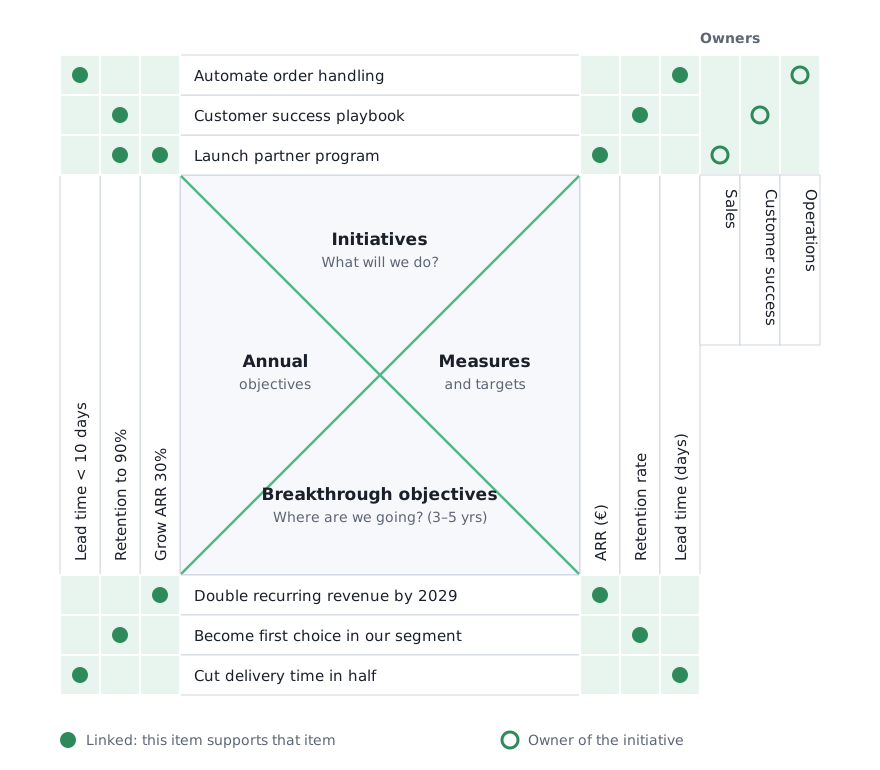
The matrix is read around the X: from long-term objectives to annual objectives, from annual objectives to initiatives, and from initiatives to measures. If an initiative isn't linked to any annual objective, it probably doesn't belong in the plan. If an annual objective has no initiative, nobody is working on it.
The X-matrix is useful but takes practice. It can feel complex to people seeing it for the first time, so many organizations start with a simpler list of priorities and owners and move to the full matrix once the process is familiar.
Common Hoshin Kanri mistakes
- Focusing on the document instead of the direction. It's easy to spend weeks polishing the X-matrix and forget why it exists. The Lean Enterprise Institute points out that Hoshin Kanri is about giving everyone a clear direction and a shared commitment to reaching it, not about producing a perfect plan on paper (pitfalls of implementing hoshin kanri). If the team can't say what the priorities are after the matrix is completed, the plan hasn't done its job.
- Too many priorities. If everything is a priority, nothing is. Hoshin Kanri works when leadership commits to a handful of objectives and says no to the rest.
- Catchball in name only. If goals are simply handed down and teams can't push back, the process loses its main benefit: realistic goals that people own.
- Skipping the reviews. Without regular PDCA check-ins, Hoshin Kanri turns back into an annual plan that is forgotten by spring.
- Underestimating the time it takes. The first planning and catchball round usually takes much longer than expected. Reserve time for it in the annual calendar, and start with a lighter version if needed rather than rushing the dialogue.
When does Hoshin Kanri fit?
Hoshin Kanri is a good choice when strategy exists on paper but doesn't show in daily work, and when the organization is willing to invest time in dialogue between levels. It is most common in manufacturing and lean organizations, but the core ideas apply anywhere.
It is a weaker fit when priorities change very quickly, because the process is built around an annual cycle. Many organizations combine it with OKRs: Hoshin Kanri sets the annual priorities and connects levels through catchball, while OKRs turn those priorities into quarterly goals for teams. Read more in OKR vs Balanced Scorecard vs Hoshin Kanri.
Sources
- Akao, Y. (ed.) (1991). Hoshin Kanri: Policy Deployment for Successful TQM. Productivity Press.
- Lean Enterprise Institute: What are the pitfalls of implementing hoshin kanri?
- Lean Enterprise Institute: Expanding the purpose of catchball